Both Sides Urge You to Respond to Heathrow Consultation
Deadline for comments on expansion plan is imminent
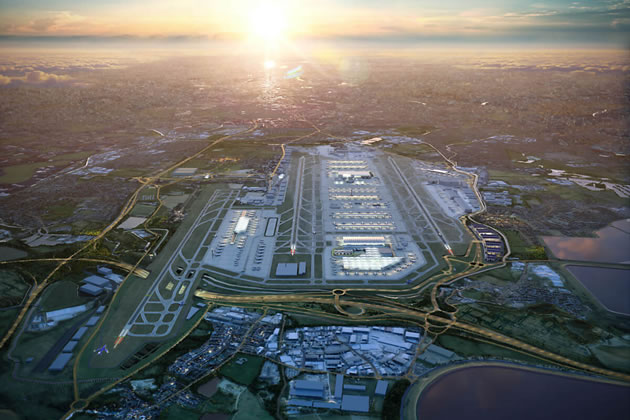
A visualisation of the masterplan for the expanded airport. Picture: Heathrow Ltd
September 1, 2026
With just days remaining before the Government’s consultation on Heathrow expansion closes on 1 September, the political and community response across South and West London has intensified, with Wandsworth Council now formally opposing the Government’s draft Heathrow Expansion National Policy Statement.
The consultation, launched in June, seeks public feedback on the planning framework that would guide any future application for a third runway and associated infrastructure. Ministers argue that expansion at the UK’s busiest airport is essential for economic growth, improved connectivity and long-term competitiveness, with claims that a third runway could support more than 60,000 new local jobs and deliver up to £42 billion in economic benefits. Supporters point to Heathrow’s role as a global hub, handling 84.5 million passengers last year and supporting more than 80,000 on-site jobs, many of them held by West London residents. They also highlight that 70 per cent of Britain’s air cargo travels through Heathrow, underpinning supply chains nationwide, and note that Parliament has previously backed expansion and that the Supreme Court has ruled the project can proceed within environmental limits.
Opposition, however, has grown more organised and more vocal. Wandsworth Council has issued a detailed and strongly worded response to the consultation, co-signed with six other boroughs, warning that the draft planning framework fails to address fundamental concerns around noise, air quality, climate impacts, public health and surface transport provision. In the joint letter, council leader Robert Morritt argues that the criteria at the heart of the consultation do not set robust enough measures to assess whether a third runway could meet the Government’s own tests. He says the borough already experiences aircraft noise that interferes with everyday life for those living, working or studying locally, and that residents rightly expect quieter skies and cleaner air rather than an uncertain future of more noise, worse air quality, increased flights overhead and loss of respite. Morritt says the Government’s consultation highlights the need for strong commitments on noise, air quality, climate obligations and public health, and that Wandsworth does not believe a third runway would or should pass those tests. He urges the Government to think again and pursue an approach that does not come at the expense of local communities, noting that expansion has recently been approved elsewhere, including at Gatwick.
The council’s official response raises concerns that residents could face increased aircraft noise, worsened air quality, greater pressure on transport networks and further disruption to daily life, including the prospect of more night flights and reduced periods of respite. Wandsworth has a long-standing record of opposing Heathrow expansion and is a core member of the No 3rd Runway Coalition alongside neighbouring boroughs and community organisations. The joint letter has been co-signed by the leaders of Richmond, Sutton, Southwark, Hillingdon, Kingston and Windsor and Maidenhead, reflecting a broad alliance of local authorities who argue that the draft policy framework does not demonstrate that a third runway could meet the Government’s own tests on climate, air quality, noise and economic growth.
Environmental groups, including Friends of the Earth, have warned that expansion is incompatible with the UK’s climate commitments. Government analysis suggests a third runway could increase aviation emissions by around six million tonnes of CO₂ every year, while nitrogen oxide emissions could rise by more than half and PM2.5 pollution by 60 per cent. Campaigners also highlight noise impacts, with assessments indicating that up to 4.65 million people could be affected — more than at any other airport in the world.
Local MPs have raised concerns too. Putney MP Fleur Anderson is urging residents to respond before the deadline, warning that communities under existing flight paths already experience aircraft overhead every ninety seconds at busy times. She argues that expansion would mean hundreds more flights, more noise, more air pollution and greater pressure on the environment, and has submitted a formal objection to the consultation. Anderson says the Government has not demonstrated a convincing need for expansion and that the costs to communities such as Putney are significant.
Campaign groups say the consultation’s timing — launched on Clean Air Day and running over the summer holidays — limited public scrutiny. They warn that expansion could lead to the displacement of residents, major construction impacts and higher passenger charges, and have compared the project to HS2 in terms of scale, cost and risk. The consultation marks the latest stage in a decades-long debate over Heathrow’s future. Developers will need to show how any scheme meets four key tests on climate, air quality, noise and economic benefit before a final planning decision is made in 2029. The Government has asked the Climate Change Committee to advise on how expansion could align with legally binding net-zero targets, and airspace modernisation plans are being developed in parallel.
Wandsworth Council says it will continue working with neighbouring boroughs, MPs and community groups to oppose the expansion plans, calling on the Government to withdraw support for the project and work with local authorities on alternative solutions that better balance economic growth with environmental and community impacts. As the consultation deadline approaches, the divide remains stark: supporters see Heathrow expansion as a vital national investment, while opponents warn of environmental harm, community disruption and long-term consequences for public health and quality of life. The consultation offers one of the last opportunities for the public to influence a project that could reshape West London — and the UK’s aviation landscape — for decades to come.
The consultation marks the latest stage in a decades-long debate over Heathrow’s future. Developers will need to show how any scheme meets four key tests on climate, air quality, noise and economic benefit before a final planning decision is made in 2029. The Government has asked the Climate Change Committee to advise on how expansion could align with legally binding net-zero targets, and airspace modernisation plans are being developed in parallel.
Residents, businesses and local authorities have until 1 September to submit their views. Responses can be sent to henpsconsultation@dft.gov.uk, and campaign organisations from both sides of the debate are encouraging people to write in their own wordsYou can also respond to the consultation online.
Like Reading Articles Like This? Help Us Produce More This site remains committed to providing local community news and public interest journalism. Articles such as the one above are integral to what we do. We aim to feature as much as possible on local societies, charities based in the area, fundraising efforts by residents, community-based initiatives and even helping people find missing pets. We've always done that and won't be changing, in fact we'd like to do more. However, the readership that these stories generates is often below that needed to cover the cost of producing them. Our financial resources are limited and the local media environment is intensely competitive so there is a constraint on what we can do. We are therefore asking our readers to consider offering financial support to these efforts. Any money given will help support community and public interest news and the expansion of our coverage in this area. A suggested monthly payment is £8 but we would be grateful for any amount for instance if you think this site offers the equivalent value of a subscription to a daily printed newspaper you may wish to consider £20 per month. If neither of these amounts is suitable for you then contact info@neighbournet.com and we can set up an alternative. All payments are made through a secure web site. One-off donations are also appreciated. Choose The Amount You Wish To Contribute. If you do support us in this way we'd be interested to hear what kind of articles you would like to see more of on the site – send your suggestions to the editor. For businesses we offer the chance to be a corporate sponsor of community content on the site. For £30 plus VAT per month you will be the designated sponsor of at least one article a month with your logo appearing if supplied. If there is a specific community group or initiative you'd like to support we can make sure your sponsorship is featured on related content for a one off payment of £50 plus VAT. All payments are made through a secure web site. |